Upgrades and Addon Features For ID Card Printers
When purchasing ID Card Printers, many different optional features can be added. However, one thing to keep in mind is that some of these ID card printer add-ons can only be installed by the manufacturer at the time of purchase. Some credential printer addons can be installed by an ADVANTIDGE technician, and lastly, some completely field upgradeable. One general rule of thumb that you should always adhere to is to never assume that a feature/addon can be installed at a later date. Always question the installation method of an Identification card printer’s features. Out of the box, the only consistent feature that you can assume when purchasing any ID card printer is being able to print on one side of an ID.
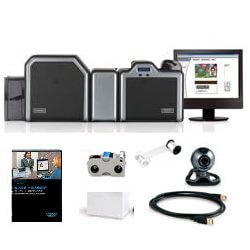
Some add-on features for ID card printers include:
- Double-sided Printing – Also called duplex printing, this feature makes printing on the front and back portions of plastic IDs possible.
- High Capacity Input/Output Card Hopper – High-capacity input hoppers allow you to load additional blank cards for uninterrupted high-volume printing. On the other hand, high-capacity output hoppers securely collect and stack your cards once printing cards are finished.
- Magnetic Stripe Encoding – Magnetic stripe encoding allows you to store variable data such as an ID number, an account nu
member or a security code onto the magnetic stripe of a card. - Smart Card Encoding (iClass /Proximity) – Cards with embedded smart chips can hold 100x more data than a normal magnetic stripe card. By adding smart card encoding to your printer, you will be able to expand/increase your ID’s functionality.
- USB / Ethernet / Wireless – This allows your printer to connect to your internal network so computers can print and encode cards remotely. A WiFi module allows ID card printers to connect to the internal network wirelessly, allowing computers to print and encode cards without being directly connected to them.
- Lamination – Adds overlay protection, and also adds the possibility of holographic security features, making your ID cards last longer while making them harder to duplicate/copy. Lamination upgrades can be one-sided or double-sided.
- RFID Encoding – Also known as radio frequency identification, RFID is a secure identification technology that relies on radio waves for communication between an RFID reader and RFID tags. Unlike magnetic stripes or barcodes, RFID-enabled cards don’t need to be in direct contact or near an RFID reader to be read.